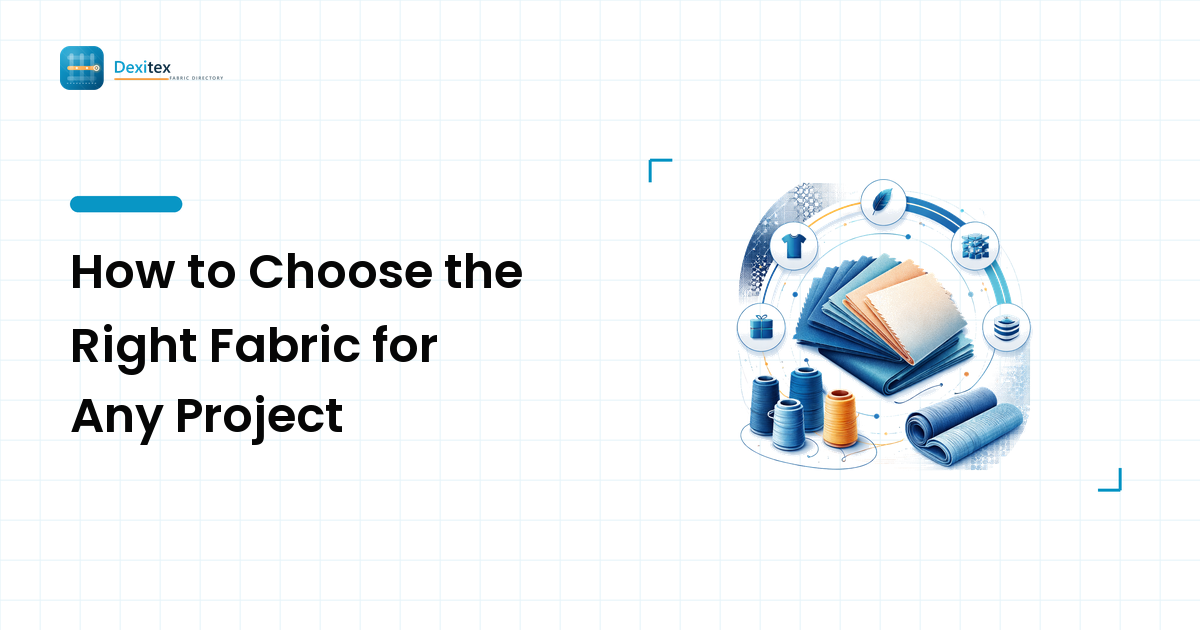
Choosing fabric feels overwhelming because most people start from the fabric — scrolling hundreds of options — instead of starting from the project. Flip it around and the decision collapses into five answerable questions: what the item must do, what weight it needs, which fibre behaviour suits it, whether it wants a woven or a knit, and what care routine it will realistically get.
This guide walks that framework in order, with typical spec ranges for the most common projects. As always on Dexitex: the numbers are typical ranges, not guarantees — mills and lots vary, so verify the spec sheet (and order a swatch) before committing money or a production run. If terms like GSM, warp, or interlock are new, read the fabric specs explainer first — this guide builds directly on it.
Question 1 — What must the item actually do?
Write down the job before you look at a single listing. Useful prompts:
- Movement: does it need to stretch with a body (activewear, tees, fitted dresses) or hold a silhouette (structured shirts, trousers, bags)?
- Exposure: sun, sweat, abrasion, rain, spills? A tote strap and an evening blouse live in different worlds.
- Contact: next to skin (softness and breathability matter) or an outer layer (durability and structure matter more)?
- Life expectancy: a costume worn twice and a daily-wear work shirt justify different fabric budgets.
Every later decision is just this job description translated into specs.
Question 2 — What weight does it need?
Weight (GSM) is the fastest filter. Typical zones by project — treat the edges as soft:
| Project | Typical weight zone | Notes |
|---|---|---|
| Flowy blouses, linings, summer dresses | ~60–140 GSM | Drape first; may be semi-sheer |
| Dress shirts, poplin/chambray tops | ~100–160 GSM | Crisp, opaque enough for daylight |
| T-shirts (single jersey) | ~140–200 GSM | Above ~220 GSM reads "heavyweight tee" |
| Sweatshirts (French terry/fleece) | ~240–400 GSM | Loop or brushed back for warmth |
| Trousers, chinos (twill) | ~200–320 GSM | Structure without board-stiffness |
| Denim jeans | ~10–14 oz/yd² (~340–475 GSM) | Denim is usually quoted in oz/yd² |
| Tote bags, light canvas goods | ~280–400 GSM | Abrasion resistance matters |
| Upholstery | often 350 GSM+ | Judged by rub-count (abrasion tests) more than GSM alone |
Two habits keep this honest. First, when a listing omits GSM, ask — a supplier who cannot state weight cannot support a spec-based decision. Second, remember that weight interacts with construction: a 250 GSM interlock and a 250 GSM canvas share nothing but a number.
Question 3 — Which fibre behaviour fits?
Pick the fibre by the property the job depends on most:
- Breathability and next-to-skin comfort → cotton, linen, or lyocell-type fibres. Cotton is the default for a reason; linen wins in heat but wrinkles enthusiastically.
- Durability and easy care → polyester or nylon, or a poly/cotton blend. Polyester dries fast and shrugs off wrinkles; the trade-off is lower absorbency and a tendency to hold odours.
- Warmth without weight → wool. It insulates even damp and resists odour, but most wools demand gentle washing.
- Stretch and recovery → add elastane. Even 2–5% transforms fit retention in leggings, fitted tees, and stretch wovens. Check recovery, not just stretch — fabric that stretches and stays stretched is worse than no stretch at all.
- Drape and fluidity → viscose/rayon, modal, silk, or fine lightweight wovens. Beautiful movement; typically more care-sensitive.
Blends let you buy two behaviours at once — at a price. Every percentage point of polyester in a cotton blend buys durability and wrinkle resistance and spends breathability. There is no free lunch, only a recipe tuned to the job; the label tells you the recipe, the spec sheet confirms it.
A sustainability note, kept honest: no fibre is simply "eco-friendly." Cotton is natural but can be water- and pesticide-intensive unless certified organic; recycled polyester diverts waste but still sheds microfibres in the wash. If environmental impact drives your choice, look for specific, scoped certifications (GOTS for organic fibre content and processing, GRS for recycled content, OEKO-TEX for tested harmful substances) rather than marketing adjectives.
Question 4 — Woven or knit?
The construction decision is usually the easiest once the job is written down:
- Choose a woven when the item must hold a shape, take structure (collars, plackets, pleats), or survive abrasion: dress shirts, trousers, jackets, bags, upholstery. Expect little stretch unless elastane is added.
- Choose a knit when the item must move with a body or pull on without closures: tees, activewear, underwear, baby clothes, casual dresses. Knits are forgiving of fit but less forgiving of construction sloppiness — seams must stretch too.
Within each family, pick the specific construction for the finish you want: plain weave for crispness, twill for drape-with-durability, satin for lustre; single jersey for classic tees, interlock for opacity and stability, rib for cuffs and clingy fits, French terry for sweats. The fabric basics guide covers what each of these is.
Question 5 — What care will it really get?
Be brutally realistic: a fabric that needs hand-washing will not survive a household that machine-washes everything warm. Care requirements are specs too — shrinkage percentage, wash temperature, drying method — and they should be read before purchase, not after the first laundry accident. Two checks:
- Shrinkage: quality spec sheets quote a maximum after a standard wash test (often in the low single digits for pre-shrunk cotton). Unstated shrinkage on a cotton knit is a risk you are accepting blind.
- Care compatibility: wool and viscose reward gentleness; polyester and nylon tolerate neglect. Match the fibre to the launderer, not the ideal.
Our fabric care guide goes deep on washing, shrinkage, and pilling by fibre — worth reading before you commit to a care-sensitive material.
Worked examples
A daily-wear T-shirt. Job: next-to-skin comfort, moves with the body, weekly machine wash. → Knit (single jersey), cotton or cotton/elastane 95/5, roughly 160–200 GSM for an opaque, substantial feel. Verify shrinkage on the spec sheet; pre-shrunk or compacted jersey saves grief.
A market tote. Job: carries weight, abrasion, no stretch wanted, rarely washed. → Woven (canvas/duck), cotton or poly-cotton, roughly 300–400 GSM. Durability beats hand-feel here.
A summer work shirt. Job: crisp appearance, breathable, survives office laundering. → Woven (poplin or chambray), cotton or cotton-rich blend, roughly 100–140 GSM. A touch of polyester buys wrinkle resistance for the commute; pure linen buys airflow and costs pressing time.
Leggings. Job: high stretch, full recovery, opacity under tension, frequent washing. → Knit (interlock or specialised warp knit), polyester or nylon with 15–25% elastane territory in performance fabrics. Squat-test a sample stretched over your hand for opacity; check recovery after holding a stretch.
The pattern is always the same: job → weight → fibre → construction → care. Five questions, answered in order, and the wall of options becomes a shortlist of two or three fabrics — which you then confirm by swatch and spec sheet, never by product photo.
FAQ
What fabric should a beginner sewist start with?
A mid-weight, stable woven cotton — quilting cotton, poplin, or chambray around 100–150 GSM. It presses well, feeds evenly, doesn't stretch while you sew, and forgives unpicking. Save knits and slippery drapey fabrics for after your first few woven projects.
How much extra fabric should I buy for shrinkage?
For cottons without a stated shrinkage spec, a common practice is buying roughly 5–10% extra and pre-washing before cutting. If the spec sheet states a tested maximum shrinkage, trust that figure instead — it is exactly what the number exists for.
Is a fabric swatch really necessary before ordering?
For anything beyond a trivial purchase, yes. A swatch verifies hand-feel, drape, opacity, and true colour — none of which survive a product photo — and lets you weigh a measured square to sanity-check the stated GSM. Professional buyers never skip sampling; neither should you.
Which lasts longer, natural or synthetic fabric?
As a rule of thumb, nylon and polyester outlast most natural fibres under abrasion and repeated washing, which is why workwear and outdoor gear lean synthetic. But construction and yarn quality matter as much as fibre: a dense cotton canvas outlasts a flimsy polyester chiffon. Judge the whole spec, not the fibre name.
Shortlist made? Put your candidates side by side on Dexitex — every fabric entry documents composition, GSM, construction, uses, and care in the same structured format, so comparisons take minutes instead of guesswork. Start at the Dexitex fabric reference.