Linen is not a look, a colour, or a texture — it is a fibre. The word names cloth made from flax, and nothing else. Everything sold as "linen-look", "linen-feel", or "linen-effect" is something else wearing linen's appearance, and a "linen blend" can be anywhere from mostly flax to barely flax at all.
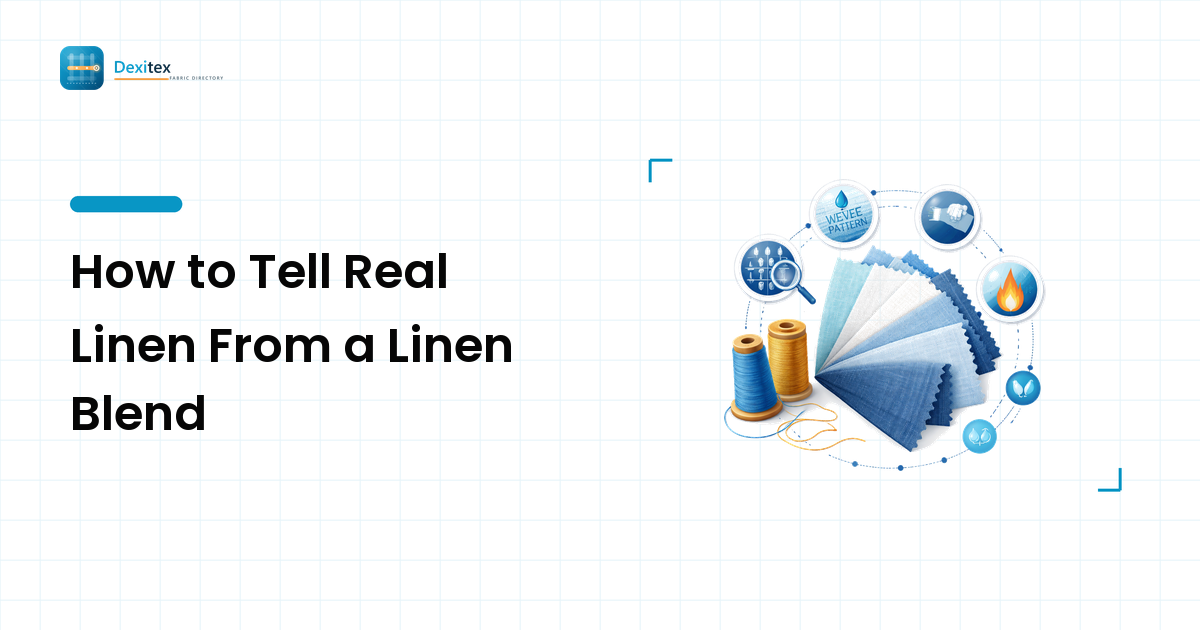
The key takeaway: read the composition label first, then confirm it with your hands. A label tells you the percentages; the crease test, the hand-feel, the slub pattern, and a drop of water tell you whether those percentages behave the way you expect. Neither alone is enough, and neither replaces the spec sheet when real money is involved.
What "linen" actually means
Linen is the fabric made from the bast fibres — the long fibres in the stem — of the flax plant. On labels and spec sheets you will see the fibre called flax or linen; both refer to the same material, and which word appears often just depends on the market and the labelling convention in force.
That matters because linen's properties come from the fibre, not the weave. Flax fibre is long, stiff, and highly absorbent, which is why linen feels dry and cool, creases sharply, and is the strongest of the common natural plant fibres. A polyester fabric woven with a loose, slubby, linen-ish texture reproduces the appearance and none of the mechanism — a fuller comparison of the four natural fibres and what each one physically does sits in the natural fibres guide.
The vocabulary that hides a blend
These terms describe an aesthetic, not a fibre content:
- Linen-look / linen-touch / linen-effect / linen-style. Marketing language for a fabric that imitates linen's slubbed, matte surface. Often polyester, viscose, or a cotton slub.
- Washed linen / stone-washed linen. A finish, not a composition claim — it can be pure flax that has been mechanically or enzymatically softened, or a blend given the same treatment.
- Linen blend. Honest, but incomplete. Ask what it is blended with and in what ratio.
- European Flax and similar origin schemes. These certify where the flax was grown and how it is traced through the chain. They speak to provenance, not to the fabric's weight, yarn quality, or finish.
Start with the composition label
In most consumer markets, textile products carry a fibre-content label by law, listed by percentage. This is the single most reliable piece of information you will get in a shop, so read it before you touch anything.
What to look for:
- "100% linen" or "100% flax" — the real thing, though quality within that still varies enormously with yarn fineness, weave, and finish.
- A percentage split such as linen with cotton, viscose, or polyester. As a working rule of thumb, the fibre with the majority share drives the fabric's behaviour; once flax drops below roughly half, you are buying a cotton or viscose fabric with a linen accent, not a linen fabric.
- No fibre content at all, or only a care symbol and a marketing phrase. In a shop, treat that as an unanswered question. In sourcing, treat it as a reason to request a documented spec sheet before sampling.
Labels do get things wrong, and a body-fabric label can ignore contrast panels or linings. That is why the physical tests below exist — not to overrule the label, but to check that the cloth in your hands is consistent with it.
Five checks you can do with the fabric in front of you
None of these is conclusive on its own. Run several; they converge fast.
1. The crush test
Take a handful of the fabric, squeeze it hard for a few seconds, then open your hand.
- Linen creases immediately and sharply, with hard, angular fold lines that stay put. Flax has very low elasticity — the fibre does not spring back, so the crease is a physical record of the fold.
- Cotton also creases, but the lines are softer and rounder, and a cotton-rich blend releases some of them as the cloth relaxes.
- Polyester and most synthetics barely crease at all, or the creases fall out within seconds. That recovery is the whole point of putting polyester into a linen blend, and it is the easiest tell that flax is not doing the work.
If a fabric is sold as linen and comes out of your fist looking undisturbed, the label is where you look next.
2. Hand-feel and thermal touch
Press your palm flat against the fabric for a moment. Linen feels cool and dry on first contact and stays that way — flax conducts heat away from your skin efficiently. Crisp, unwashed linen also has a slight stiffness, almost a rustle, and a body that makes it stand away from a surface rather than pooling.
Look-alikes read differently: viscose feels cool at first but slippery, and it drapes limply where linen holds structure; polyester warms up quickly under your hand and can feel faintly waxy. Washed linen loses the crispness but keeps the dry, cool touch.
3. Look at the slubs
Slubs are the thicker spots along the yarn, and they are the visual signature people associate with linen. The point is not that slubs are present — anyone can weave a slub yarn — but that real linen's slubs are irregular. Flax fibre varies naturally in thickness, so the thick spots appear at random intervals and in random sizes across the cloth.
Imitation slub fabrics use engineered slub yarn, so the irregularity is programmed. Look across a wide area: if the same slub pattern repeats at a regular interval, or the texture reads as uniformly, evenly "rustic", you are probably looking at a manufactured effect.
4. The water-drop test
Put a small drop of water on an inconspicuous area. Linen is highly absorbent and hydrophilic — the drop sinks in quickly and spreads into a dark patch. Polyester is hydrophobic; water beads and sits on the surface, or wets out slowly and unevenly.
The limits matter here. Cotton absorbs readily too, so this test separates natural cellulose from synthetic, not linen from cotton. Water-repellent finishes will also make genuine linen bead, so a failed drop test on a finished or coated fabric proves nothing by itself.
5. Weight and price sanity check
Linen comes from a labour-intensive fibre chain — retting, scutching, and hackling the flax stems before spinning — and is typically priced above comparable cotton, so linen-branded goods at a basic-cotton price deserve a closer look at the label. Weight is a sanity check of the same kind: linen spans everything from sheer handkerchief and shirting cloth to heavy furnishing weights, so treat any quoted GSM (grams per square metre) as guidance and verify it on the actual spec sheet — it varies by mill and by lot.
The burn test, and when it is worth doing
The burn test is the most decisive non-laboratory check, and it is destructive, so it belongs on a spare thread pulled from a seam allowance or a swatch — never on a finished garment you intend to keep. Do it over a non-flammable surface, away from anything that can catch, with water to hand.
What each family does:
- Cellulose fibres (linen, cotton, viscose) ignite readily, burn steadily with a smell close to burning paper or leaves, and leave a soft, light grey ash that crumbles between your fingers. There is no hard residue.
- Thermoplastic synthetics (polyester, nylon) shrink away from the flame, melt, drip, smell chemical or sweet rather than papery, and cool into a hard bead you can feel with a fingernail.
- Protein fibres (wool, silk) smell of burning hair and tend to self-extinguish, leaving a brittle, crushable black residue.
A blend gives you a mixed result — that is precisely why the test is useful. Cellulose ash with hard melted beads embedded in it means synthetic content is present regardless of what the tag says. Two caveats: the test cannot tell linen from cotton or viscose, since all three are cellulose, and flame-retardant or heavy coating finishes can distort the result.
What each blend partner actually changes
A linen blend is not a compromise by default; it is a deliberate trade. Knowing which trade you are buying is the real skill:
- Linen/cotton. The most common pairing. Cotton adds softness up front and reduces creasing slightly, and it lowers cost. You lose some of linen's crispness, coolness, and dry hand in proportion to how much cotton is in there.
- Linen/viscose. Viscose adds fluid drape and a smoother, cooler surface — useful for softer garments. The cost is strength: viscose is notably weaker when wet and more prone to shrinkage and distortion in the wash, so care gets more demanding, not less.
- Linen/polyester. Bought for wrinkle recovery and dimensional stability, and often for price. The trade is breathability and moisture handling — polyester does not absorb moisture the way flax does, so the fabric loses part of the reason people choose linen in hot weather.
- Linen/elastane. A small elastane share adds stretch and recovery for fitted garments, but elastane reacts badly to high heat, so check the care instructions.
- Ramie and hemp. Relatives rather than substitutes — both are bast fibres with a linen-like crispness, and both appear legitimately on their own or blended with flax. They explain why a fabric can look like linen, be entirely natural, and still not be linen.
If you are buying beyond a single metre
For sourcing quantities, hand tests are a screen, not a decision. Ask the supplier for the documented composition with percentages, the weight in GSM, the construction, the finish applied, and the shrinkage figures. Then order a swatch and wash it the way the end use will be washed — shrinkage and hand both change after the first laundering, and the softness you felt on the sales sample may be a finish that partly washes out. If a supplier cannot produce a composition breakdown on paper, that absence is your answer.
FAQ
How can I tell if linen is real without a burn test?
Combine the label with three physical checks: crush a handful and look for sharp, persistent creases; feel for a cool, dry, slightly stiff hand; and check that the slubs are irregular rather than repeating. Add a water drop to rule out polyester. Any one of these can mislead, but agreement across all four is a strong signal.
Is a linen blend worse than 100% linen?
Not automatically — it is a different fabric with a different job. A cotton or elastane blend can be the better choice for softness, cost, or fit, and blends are widely used for good reasons. What matters is that you know the ratio and what it costs you: less crease character, less coolness, or less absorbency, depending on the partner fibre.
Does real linen always wrinkle?
Real linen always creases readily, because flax has very low elasticity — that is a property of the fibre, not a defect. Washing, softening finishes, and heavier weights can soften how the creases read, and blending with polyester suppresses them. But a fabric that resists wrinkling entirely is not behaving like flax.
What does "linen-look" mean on a label?
It means the fabric imitates linen's slubbed, matte appearance without necessarily containing any flax. It is a description of the aesthetic, not a fibre-content claim. Read the composition percentages nearby — those are the part with any legal weight behind them.
Can washed or softened linen still be 100% linen?
Yes. Washing, tumbling, and enzyme or stone-washing are finishes applied to soften the hand, and they are routinely applied to pure flax. Softness on its own tells you about the finish, not the fibre — check the composition label and the dry, cool touch, both of which survive softening.
Buying linen and want the numbers behind it? Dexitex documents flax and the fabrics made from it by composition, weight, construction, properties, uses, and care, so you can compare a linen shirting against a cotton-linen blend on the specs rather than on the marketing. Start with the linen fibre and fabric entries on Dexitex, then verify the spec sheet with your supplier before you commit.