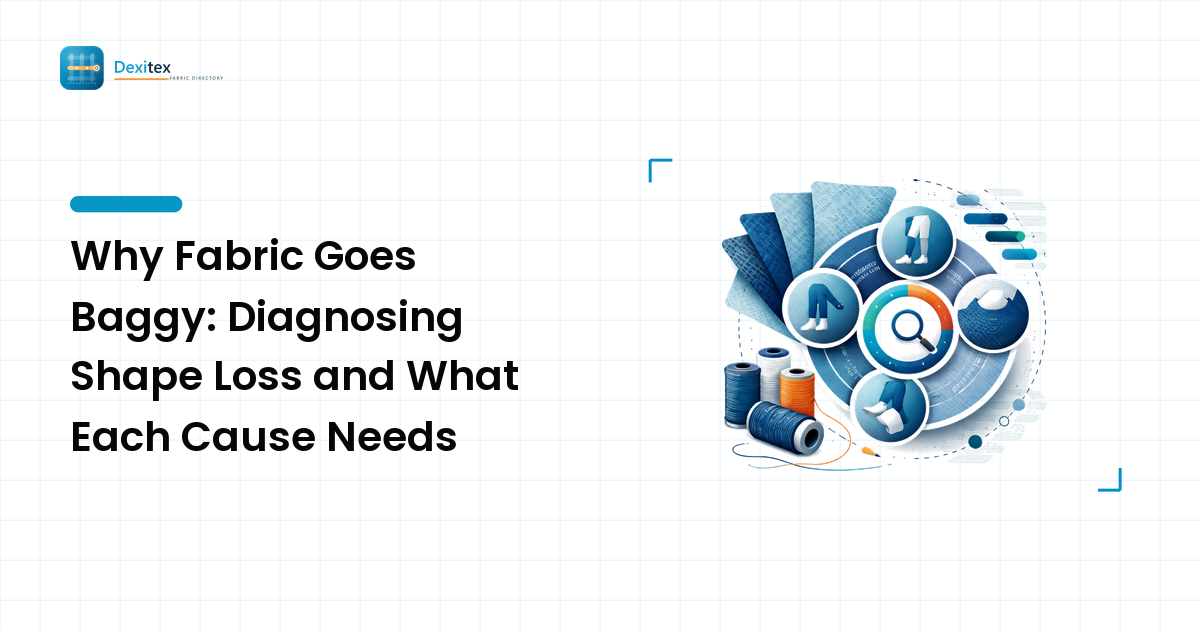
Knees that bulge by lunchtime. Cuffs that stop gripping. A T-shirt neckline that flares out while the rest of the shirt is fine. Shape loss is the most common complaint about a fabric after colour, and it is the one most often blamed on the wrong thing — usually the wash.
The takeaway up front: bagging has four distinct causes, only one of them is a care mistake, and a single test tells you which one you have. Two of the four were decided before the fabric reached you, on the composition and construction lines of the spec sheet. Diagnose first; the fix follows.
The test: does the shape come back?
Stretch and recovery are two different properties. Elongation is how far a fabric moves under load; recovery is how much of that it takes back when the load comes off. Everyday bagging is almost always a recovery problem, and you can separate the causes by giving the fabric a chance to recover.
Take the baggy garment out of wear, let it rest flat for a few hours, then wash and dry it as the label allows and look again:
- The shape comes fully back. Normal elongation. The fabric is doing what it is built to do, and the garment simply relaxes across a day. This is a fit and construction question, not a fault.
- Most of it comes back, but the area is a little slacker each time. Creep in a fibre or a structure with limited recovery. It will keep going.
- Nothing comes back. Permanent set: the elastic component is degraded, or the yarns have shifted within the structure. No care routine reverses this.
That result narrows you to one of the four causes below.
Cause 1: the fibre has no recovery to give
Fibres differ enormously here, and the difference is physical rather than a matter of quality.
Cellulosics — cotton, viscose, linen, and their relatives — elongate under load and return poorly. They have no built-in springiness, so a cotton jersey knee or a viscose elbow stays where you put it until washing relaxes the yarns back. Wool behaves better, because its natural crimp acts a little like a spring. Polyester and nylon recover better than the cellulosics, and elastane is the fibre that exists specifically to pull a fabric back.
Diagnose it: read the composition. A 100% cotton or 100% viscose knit that bags at the load points is behaving exactly as its fibre content predicts.
What it needs: a different fabric, not a different wash. Either a fibre with better recovery, or a small elastane content, or a construction that resists elongation (see cause 2). The synthetic fibres and blends guide covers how the man-made fibres behave under load.
Cause 2: the construction lets it happen
Two fabrics with identical composition can behave completely differently, because structure carries much of the load.
In knits, the loops themselves move before the yarn does. Single jersey — the standard lightweight T-shirt knit — is the most mobile common structure, which is why necklines and cuffs are so often cut in rib and why interlock and other double knits hold their shape better. Loose gauge, low-twist yarn, and low fabric weight all increase mobility. A knit at the bottom of the typical weight range for its use is more prone to bagging than a heavier one in the same fibre, though heavier is not automatically better — you are trading drape and breathability for stability. Typical weight ranges by end use vary widely by mill, so verify the spec sheet rather than assuming.
In wovens, the structure is far more stable, so bagging shows up in specific places: knees and seats, where repeated flexing works the yarns loose, and anywhere the piece is cut on or near the bias, which is the direction a woven can stretch even without elastic fibres.
Diagnose it: compare the bagged area with the rest of the garment. If the fabric is unchanged elsewhere and slack only where it flexes, construction and placement are carrying the blame, not the wash. Stretching a spare piece and releasing it tells you the same thing in a few seconds. The vocabulary for this — gauge, weave, knit type — is in the fabric specs explainer.
What it needs: a denser or more stable construction for the load, or support built into the design — rib at cuffs and necklines, a stabilised waistband, interfacing or a lining panel where a woven is asked to flex.
Cause 3: the elastane is gone
This is the one people usually mean when they say a garment "died". A stretch fabric that used to snap back stops doing it, often quite suddenly, and the waistband or the knees go first.
Elastane is the weak link in almost any blend that contains it. Heat is the main enemy — hot washes, tumble dryers, and hot irons degrade it long before the main fibre suffers. Chlorine, body oils, sun creams, and the residue left by fabric softeners all shorten its life too, which is why swimwear and activewear lose recovery faster than the same blend in a casual garment.
Diagnose it: the fabric contains elastane, it recovered well when new, and it now fails the recovery test completely. Damage is usually worst where heat and stress combine — waistbands, cuffs, seams.
What it needs: prevention, because degraded elastane does not regenerate. Wash cool, skip the softener, air-dry, and keep hot irons off it. Full fibre-by-fibre care rules are in the fabric care guide.
Cause 4: not enough stretch fibre for the job — or the wrong fit
The last cause is a specification mismatch rather than a failure.
Elastane content is chosen for a purpose. Comfort-stretch fabrics — everyday shirting, jeans, casual knits — commonly sit at a low single-digit percentage, enough to take the edge off a rigid fabric. Performance and shapewear fabrics carry substantially more, along with a construction designed to hold it. A comfort-stretch fabric asked to do a compression job will bag, and no amount of careful washing changes that. Actual percentages vary by mill and end use, so read them off the spec sheet rather than a general figure.
Fit belongs in the same cause. A garment worn tighter than it was designed for lives permanently near the top of its stretch range, which is where recovery is worst and where any elastic component ages fastest. The same fabric in a looser fit can behave perfectly.
Diagnose it: the fabric recovers correctly when at rest, but not in wear — and the garment is under constant tension when worn.
What it needs: a fabric specified for the load, or a fit that does not sit at the limit. If you are sourcing, ask the supplier for stretch and recovery figures — often reported as elongation and growth — and treat them as the governing spec for anything close-fitting.
What to check before you buy
Shape retention is decided at selection, so the checks are all things you can read or test in advance:
- Composition, with the elastic content stated as a percentage rather than described as "stretch".
- Construction and gauge — single jersey, interlock, rib, double knit, or the weave type — because this decides how much the structure itself moves.
- Weight, against typical ranges for the end use, remembering that heavier buys stability and costs drape.
- Stretch and recovery figures, where the mill provides them.
- Finish, since some finishes affect both hand and stability.
Then do the simple physical check on the sample: stretch it, hold it, release it, and see what comes back. And verify the spec sheet before committing to a run — figures vary between mills and between lots, and a lab dip or a sample tells you what this fabric does rather than what its category usually does. How to read those numbers properly is covered in reading a fabric spec sheet.
FAQ
Why do my leggings go baggy at the knees?
Usually degraded elastane, sometimes an elastane content too low for a close fit. Run the recovery test: if a cool wash and a rest bring the shape back, it is normal elongation and the fabric is fine; if it does not, the elastic component has lost its recovery and nothing brings it back.
Can a stretched fabric be restored?
Only when the shape loss is elongation rather than permanent set. Washing and drying as the label allows lets relaxed yarns recover, and that is genuinely effective for cotton knits. Once elastane has degraded or yarns have shifted within the structure, the change is permanent.
Does washing cause bagging?
Not directly, but heat accelerates the cause that is permanent. Hot water, tumble drying, and hot ironing degrade elastane far faster than the fibres around it. Cool washing and air drying will not fix a poorly specified fabric, though they will make a well-specified one last considerably longer.
Which fabrics hold their shape best?
As a rule of thumb, denser constructions in recovery-capable fibres: interlock and double knits over single jersey, ribs at the load points, wool over cotton for resilience, and blends with a stated elastic content for anything close-fitting. Trade-offs come with each of those, so match the choice to what the garment must actually do.
Bagging is a specification problem far more often than a laundry one. Read the composition, look at the construction, and run the recovery test before blaming the wash. To compare composition, construction, weight, and care specs side by side before you commit, browse the fabric reference library on Dexitex.