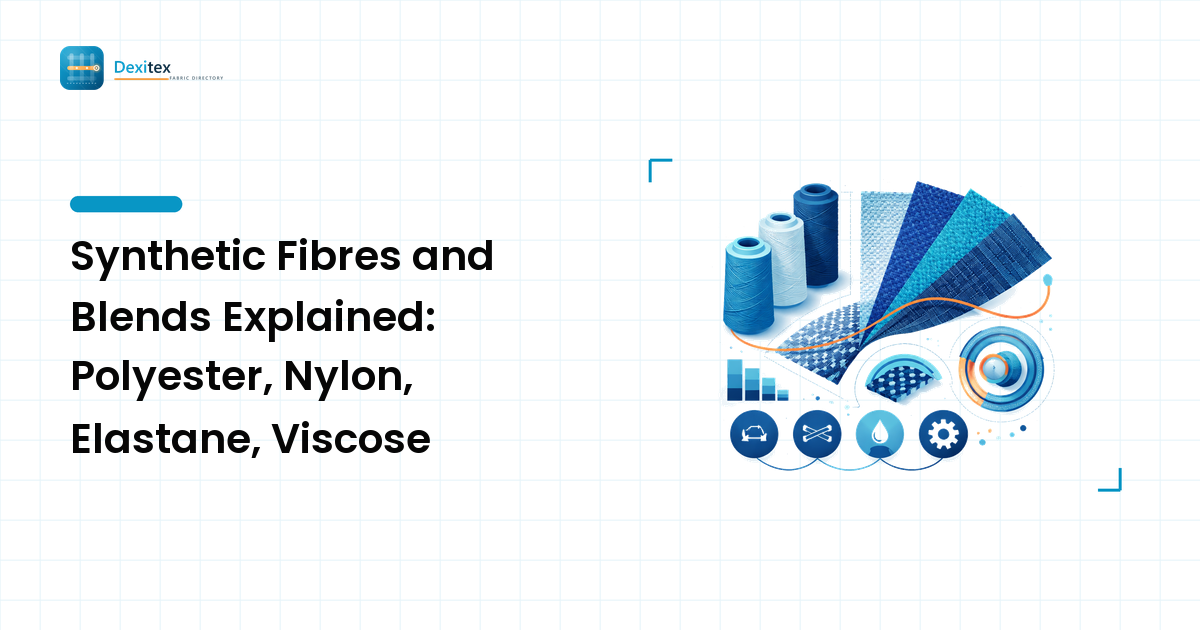
Most of the world's fabric is no longer purely natural. Walk through any wardrobe and you will find polyester, nylon, elastane, and viscose — on their own and, more often, blended into cotton, wool, and each other. These fibres exist because they solve problems natural fibres cannot: cheap strength, permanent stretch, wrinkle resistance, fast drying, and engineered performance. Learn how each behaves and a blend label stops being marketing noise and starts telling you exactly how a fabric will feel, wear, and wash.
This guide explains the manufactured fibres by their properties, the way its companion natural fibres guide explains cotton, linen, wool, and silk. Two things to hold onto throughout. First, one word on a label rarely tells the whole story — construction and finish still shape the final fabric, and composition is only half of it (weight and weave or knit are the other half, covered in the fabric specs guide). Second, any figures below are typical ranges, not guarantees — grade, denier, and finish vary by mill and lot, so always verify the actual spec sheet before you commit.
Synthetic vs manufactured: a distinction worth making
Not every non-natural fibre is a plastic. The umbrella term is manufactured fibres, and it splits in two:
- True synthetics are built from petrochemical polymers — polyester, nylon, acrylic, and elastane. They are thermoplastic, meaning they soften and melt with heat rather than char, which drives both their easy-care behaviour and their care limits.
- Regenerated cellulosics — viscose (rayon), modal, lyocell, and cupro — start from a natural raw material (usually wood pulp) that is chemically dissolved and reformed into fibre. They are not thermoplastic and behave far more like cotton than like plastic.
That split predicts a lot. True synthetics are strong, springy, and water-repelling; regenerated cellulosics are soft, absorbent, and fluid but weaker when wet. Keep the two families straight and viscose stops being confusing.
Polyester: the workhorse
Polyester is the most-used fibre on earth, and for good reason. It is strong, wrinkle-resistant, colour-fast, and dimensionally stable — it holds its shape, resists shrinking and stretching, and dries quickly because it absorbs very little moisture. That low absorbency is the key to its personality: water sits on the surface rather than soaking in, so polyester dries fast and wicks well when engineered to, but can feel clammy and hold odour because sweat has nowhere to go.
Its other defining trait is thermoplasticity. Heat sets polyester permanently — which is how pleats and performance textures are locked in — but it also means a hot iron or dryer can glaze or melt it. Polyester pills on fabrics with short surface fibres, and because the fibre is so strong those pills cling rather than falling away.
What drives polyester quality
The spec sheet, not the fibre name, tells you what you are getting:
- Filament vs staple. Continuous filament yarns are smoother and pill less; staple (short, spun) polyester feels more cotton-like but pills more.
- Denier and micro-denier. Finer filaments (microfibre) give a softer, silkier hand and better drape than coarse ones.
- Recycled (rPET). Polyester made from recycled bottles or textiles can match virgin performance; the recycled-content claim is what a GRS (Global Recycled Standard) certificate covers — verify it rather than trusting a logo.
- Finish. Moisture-wicking, anti-pill, and water-repellent finishes are applied treatments listed on the sheet, not inherent to the fibre.
Nylon (polyamide): strength and abrasion resistance
Nylon — labelled polyamide on many spec sheets — is polyester's tougher cousin. Its signature is abrasion resistance and tensile strength for its weight, which is why it dominates hosiery, backpacks, technical outerwear, and linings. It has a smoother, more elastic hand than polyester and takes dye to deep, rich colours.
Compared with polyester, nylon absorbs a little more moisture (so it is slightly slower to dry and can lose some strength when wet), and it is more sensitive to UV — prolonged sunlight degrades it faster. Like polyester it is thermoplastic and melts with heat, and it can develop a shine at friction points. When a fabric needs to survive repeated abrasion, nylon usually earns its place over polyester; when colour-fastness in strong sun and lowest cost matter more, polyester leads.
Elastane: stretch, in small doses
Elastane — sold as spandex or under the trade name Lycra — is the fibre that makes modern clothing move. It can stretch several times its length and snap back, so a small percentage transforms a fabric's fit and recovery. You rarely see it alone; it is almost always a minor partner in a blend.
The ratios matter, and they are smaller than people expect:
- 2–5% elastane in a cotton or polyester knit adds comfort stretch and stops knees and elbows bagging out — the recovery that keeps a fitted tee fitted.
- 10–20%+ appears in activewear, swimwear, and shapewear, where high stretch and firm recovery are the whole point.
Elastane's weakness is durability under heat and chemicals. It is degraded by chlorine, high heat, and some oils, which is why elastane-rich swimwear tires in chlorinated pools and why hot washing and tumble-drying shorten the life of stretch garments. A blend is only as launderable as its most sensitive fibre — treat anything with elastane gently.
Viscose, modal, and lyocell: the regenerated cellulosics
Here is where labels confuse people. Viscose (rayon) is not a true synthetic and not a natural fibre — it is regenerated cellulose, made by dissolving wood pulp and extruding it into fibre. The result behaves like a soft, fluid, highly absorbent cousin of cotton: beautiful drape, a cool hand, and excellent dye uptake, but noticeably weaker when wet and prone to shrinking or losing shape if washed carelessly. Much viscose is dry-clean or gentle-wash for exactly this reason.
Two refinements of the same idea trade up on performance:
- Modal is a stronger, wet-stable viscose (often from beech) with a soft, smooth hand — common in premium underwear and loungewear.
- Lyocell (the best-known brand is TENCEL) is made in a closed-loop solvent process that recovers and reuses most of the chemistry. It is stronger, more wet-stable, and its process is lower-impact than conventional viscose — a specific manufacturing claim, not a blanket "eco" halo.
Acrylic rounds out the common list: a true synthetic engineered as a wool substitute — soft, warm, and lightweight, but prone to pilling and less resilient than wool.
Why fabrics are blended
Almost no blend is an accident. Each fibre is hired to do a job the others cannot, and reading a blend is really reading a list of intentions:
- Cotton + polyester (e.g. 60/40 or 50/50): cotton's soft, breathable hand plus polyester's strength, wrinkle resistance, and fast drying. The classic poly-cotton compromise.
- Anything + elastane (2–5%): comfort stretch and recovery without changing the base fabric's character.
- Wool + polyester or nylon: adds durability and reduces cost and creasing in suiting, at some loss of wool's full hand and breathability.
- Viscose + linen or cotton: viscose lends drape and softness to a crisper natural fibre.
The trade-off is always there. A blend inherits the care limits of its most sensitive fibre and can be harder to recycle than a single-fibre fabric, because separating blended fibres is difficult. When you read a blend, ask what each fibre was hired to do — then decide whether the compromise suits your project. The full method for turning that into a choice is in the guide to choosing fabric for a project.
Sustainability, honestly
Synthetics carry a real and specific set of trade-offs, and honest framing means naming the mechanism, not reaching for a label:
- Fossil feedstock. Polyester, nylon, and elastane are petrochemical products. Recycled polyester (rPET) reduces virgin feedstock and is covered by the GRS standard when certified — but recycling textile-to- textile at scale is still limited, and much rPET comes from bottles, not old clothes.
- Microfibre shedding. Synthetic fabrics shed plastic microfibres in washing that current treatment plants do not fully capture. This is a genuine, fibre-level issue that no "recycled" claim resolves.
- Not biodegradable. True synthetics persist in the environment far longer than natural fibres, though they can be very durable in use, which extends a garment's life.
- Regenerated cellulosics are biodegradable and plant-derived, but conventional viscose production has used harsh chemistry and pressured forests. Lyocell's closed-loop solvent recovery and FSC-certified pulp address specific parts of that footprint — claim only what the certificate actually covers.
Keep certification scopes straight: GRS verifies recycled content and chain of custody; OEKO-TEX Standard 100 tests a finished product for harmful substances (chemical safety, not recycled content or low footprint); FSC covers responsibly sourced wood pulp. Only trust a claim that names the standard and is documented on the spec sheet.
Choosing among synthetics and blends
Match the fibre to the property the garment must deliver, then confirm weight and construction:
- For low cost, wrinkle resistance, and fast drying: polyester, ideally recycled and certified.
- For abrasion resistance and strength for weight: nylon (polyamide).
- For stretch and recovery: elastane, in the smallest dose that does the job — 2–5% for comfort, more for performance.
- For soft drape and a cool hand at lower cost than silk: viscose, or modal and lyocell for better wet strength and a lower-impact process.
Fibre is the starting point, not the finish. A 100 GSM polyester chiffon and a 600 GSM polyester fleece share a fibre and behave nothing alike, so always pair this decision with weight and construction.
FAQ
Is viscose natural or synthetic?
Neither, strictly. Viscose (rayon) is a regenerated cellulosic — made from a natural raw material, wood pulp, that is chemically dissolved and reformed into fibre. It behaves like a soft, absorbent, fluid cousin of cotton, but is noticeably weaker when wet, which is why so much viscose asks for gentle or dry cleaning.
What is the difference between polyester and nylon?
Both are strong, quick-drying thermoplastic synthetics, but nylon (polyamide) is tougher and more abrasion-resistant with a smoother, more elastic hand, while polyester is cheaper, more colour-fast, and more UV-stable. For gear that takes repeated rubbing, nylon usually wins; for low-cost, sun-stable everyday fabric, polyester does.
What does elastane actually do in a fabric?
Elastane (spandex/Lycra) provides stretch and recovery. Even 2–5% in a blend lets a fabric move with the body and snap back to shape, preventing bagging at knees and elbows. Higher percentages (10–20%+) give the firm, high stretch of activewear and swimwear. It is degraded by chlorine and heat, so stretch garments last longer with gentle, cool care.
Why are so many fabrics blended instead of pure?
Because each fibre covers another's weakness. Poly-cotton pairs cotton's comfort with polyester's durability and easy care; a touch of elastane adds recovery without changing the base fabric. The cost is that a blend inherits the care limits of its most sensitive fibre and is harder to recycle than a single-fibre fabric.
Are synthetic fibres worse for the environment than natural ones?
It depends on the mechanism, not the label. Synthetics rely on fossil feedstock, shed microfibres, and do not biodegrade — but they are durable and can use recycled content (verified by GRS). Natural fibres are renewable and biodegradable but carry their own water, land, and welfare costs. Judge each claim by its named mechanism and certification scope, not by the plastic-vs- plant framing.
Want the numbers behind each fibre? Dexitex documents polyester, nylon, elastane, viscose, and the blends built from them — by composition, weight, construction, properties, uses, and care, in one structured entry each. Compare them in the synthetic-fibre reference on Dexitex and choose your next material by its specs.