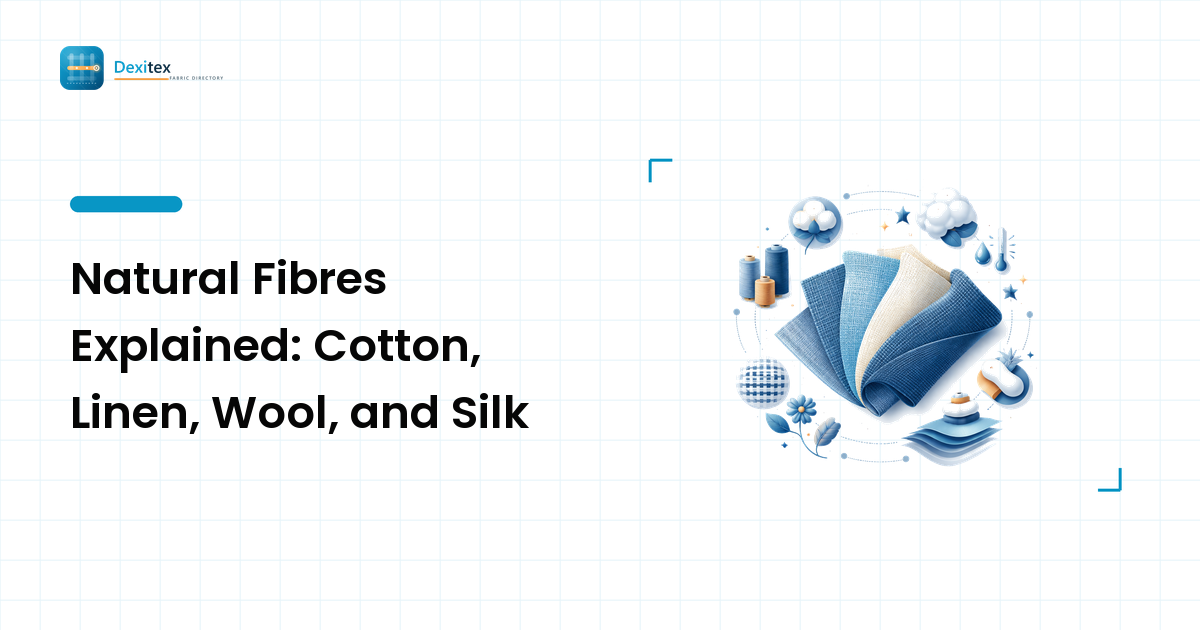
Four natural fibres carry most of the world's clothing and textiles: cotton, linen, wool, and silk. Each comes from a living source — a plant or an animal — and each has a fixed set of behaviours that no finish can fully override. Learn those behaviours and you can predict how a fabric will feel, warm, breathe, wear, and wash before you buy it.
This guide explains the four by their properties, not by marketing. Two things to keep in mind throughout. First, composition sets a fibre's rules, but construction and finish still shape the final fabric — a fibre is only half the story (weight and weave or knit are the other half, covered in the fabric specs guide). Second, any figures below are typical ranges, not guarantees — grade, spinning, and finish vary by mill and lot, so always verify the actual spec sheet before you commit.
The four natural fibres at a glance
Two are cellulose (plant) fibres and two are protein (animal) fibres, and that split predicts a lot:
- Cotton (plant). Soft, breathable, highly absorbent; wrinkles, and shrinks unless pre-treated. The default for everyday comfort.
- Linen (plant). From flax — very strong, exceptionally breathable, with a crisp, cool, dry hand; wrinkles freely.
- Wool (animal). Insulating even when damp, elastic, odour-resistant, naturally flame-resistant; can felt and shrink with heat and agitation.
- Silk (animal). Lustrous, smooth, strong for its weight; sensitive to sunlight, perspiration, and rough washing.
A useful shortcut: plant fibres breathe and absorb; protein fibres insulate and recover. Cotton and linen keep you cool and soak up moisture; wool and silk manage temperature and spring back toward their original shape.
Cotton: the comfort default
Cotton is a cellulose fibre from the seed pod (boll) of the cotton plant. It is soft, breathable, and highly absorbent — it can take up a good deal of moisture before feeling wet, which is why it feels comfortable next to skin but slow to dry. One property surprises people: cotton is stronger wet than dry, so it tolerates repeated laundering well.
Its weaknesses are the flip side of that absorbency. Cotton wrinkles, and untreated cotton shrinks on its first hot wash as tension in the yarn relaxes — which is why so much cotton is sold pre-shrunk or blended with a touch of elastane for recovery.
What drives cotton quality
Not all cotton is equal, and the spec sheet tells you why:
- Staple length. Longer fibres (staples) spin into smoother, stronger, less-pilling yarn. Extra-long-staple cottons — the category that names like Pima and Egyptian refer to — command a premium for this reason. Verify the actual grade; the name on a label is not a guarantee of staple length.
- Combed vs carded. Combing removes short fibres and debris, leaving a cleaner, stronger, smoother yarn. Carded is coarser and cheaper.
- Ring-spun vs open-end. Ring-spinning twists fibres into a finer, softer, more durable yarn; open-end (rotor) spinning is faster and cheaper but yields a coarser hand.
- Mercerising. Treating cotton with caustic soda under tension adds lustre and strength and improves dye uptake — a finish, listed on the sheet, not an inherent property of the fibre.
Linen: strong, cool, and unapologetically wrinkled
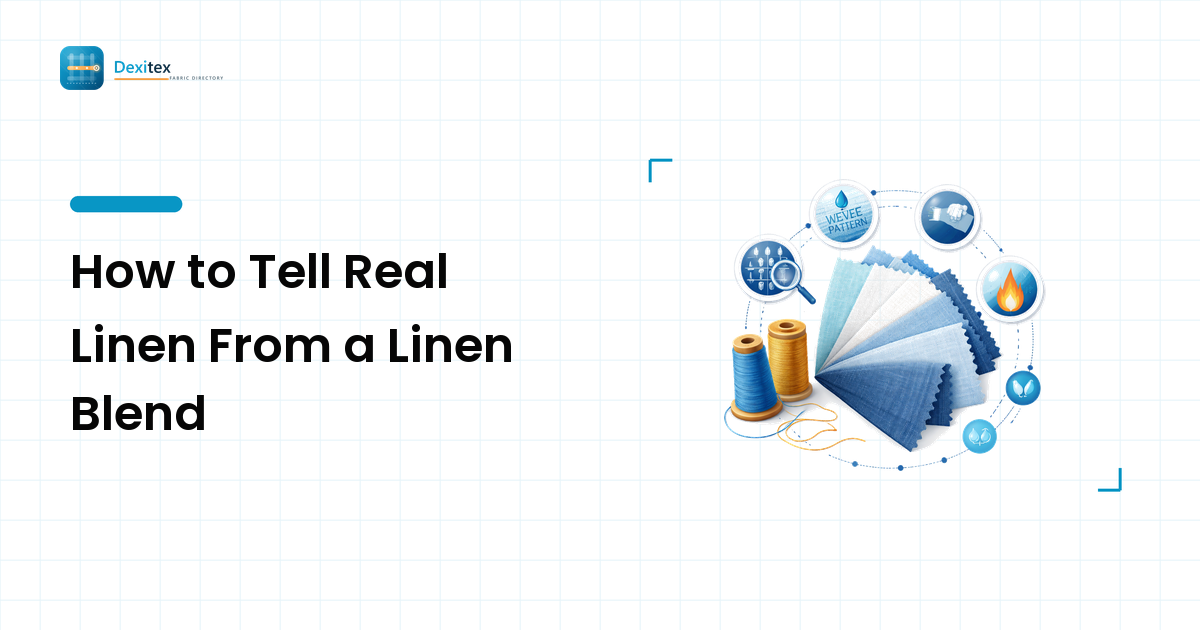
Linen comes from the bast (stem) fibres of the flax plant. It is the strongest common natural plant fibre, and — like cotton — stronger wet than dry. Its signature is thermal comfort: linen is highly breathable and wicks moisture, then releases it quickly, so it feels cool and dries fast. That makes it a warm-weather staple.
The trade-off is resilience. Linen has low elasticity, so it creases sharply and holds those creases — the relaxed wrinkle is the fibre's personality, not a defect. Natural slubs (thick spots in the yarn) are likewise characteristic of linen, not a flaw. Linen also tends to soften with every wash while keeping its strength, which is why well-used linen feels better than new.
Because flax fibre is coarser than cotton, linen quality tracks closely with how finely and evenly it is spun and how it is finished. A softened or "stone-washed" linen buys comfort up front; a crisp linen will earn its softness over time.
Wool: warmth that survives damp
Wool is a protein fibre, most often from sheep. Its defining feature is natural crimp — the waviness of each fibre traps air, and trapped air is insulation. That structure gives wool several properties at once:
- It insulates even when damp. Wool can absorb a large share of its own weight in moisture before it feels wet, and it holds warmth in conditions that flatten other fibres.
- It is naturally elastic and resilient. Wool fibres stretch and recover, so knitwear springs back rather than bagging out.
- It resists odour and flame. Wool is slow to hold body odour and is naturally flame-resistant — it tends to self-extinguish and char rather than melt, unlike thermoplastic synthetics.
The catch is felting. Wool fibres are covered in microscopic scales; add heat, moisture, and agitation and those scales lock together, shrinking the fabric irreversibly. That is why most wool asks for cool, gentle, low-agitation washing — unless it has been given a superwash treatment that coats or removes the scales to allow machine washing (check the label). Fineness also matters: merino wool is finer (measured in microns) and softer against skin than coarser wools, which is why micron count often appears on premium wool specs.
Silk: luxury with rules
Silk is a protein filament produced by silkworms as they spin their cocoons. Because each filament is continuous and remarkably smooth, silk is lustrous, lightweight, and strong for its weight, with a natural temperature-regulating quality — cool in warmth, warm in cool.
Silk is also the most demanding of the four. It is weakened by prolonged sunlight (UV degrades the protein), by perspiration and deodorants, and by alkaline detergents and rough handling. Most silk prefers gentle hand washing or dry cleaning, out of direct sun.
One terminology note: silk weight is traditionally quoted in momme (mm), not GSM — a higher momme count means a denser, more substantial silk (charmeuse and crepe de chine sit toward the lighter-to-mid range, heavier silks well above). Treat any momme figure the way you treat GSM: a guide to be verified on the spec sheet, never a quality score on its own.
Choosing between natural fibres
Match the fibre to what the property must do, then confirm weight and construction:
- For hot weather and moisture: linen leads on cooling and fast drying; cotton is softer next to skin and cheaper. Both breathe far better than most synthetics.
- For warmth, especially damp or active cold: wool, for insulation that survives moisture and springs back.
- For drape, sheen, and a luxury hand: silk — accepting the care cost.
- For everyday durability and easy care: cotton, ideally pre-shrunk or in a small-elastane blend for recovery.
Fibre is the starting point, not the finish. A 120 GSM cotton voile and a 320 GSM cotton canvas share a fibre and behave nothing alike, so pair this decision with weight and construction — the full method is in the guide to choosing fabric for a project.
Sustainability, honestly
No natural fibre is automatically "eco-friendly," and the honest picture is about specific mechanisms and their limits:
- Cotton is renewable and biodegradable, but conventional cotton can be water- and pesticide-intensive depending on where and how it is grown. Organic cotton reduces synthetic pesticide and fertiliser inputs; certified organic content is what a GOTS claim covers.
- Linen (flax) is often grown with fewer inputs than cotton and is biodegradable, though processing method (water vs chemical retting) affects the footprint.
- Wool is renewable, durable, and biodegradable, but carries livestock emissions and animal-welfare considerations; the Responsible Wool Standard (RWS) addresses welfare and land management specifically.
- Silk is biodegradable, but conventional sericulture ends the pupa's life cycle inside the cocoon; "peace" or Ahimsa silk is an alternative with a different yield and hand.
Two certifications get conflated, so keep their scopes straight: GOTS verifies organic fibre content plus environmental and social criteria through processing, while OEKO-TEX Standard 100 tests a finished product for harmful substances — it is a chemical-safety claim, not proof of organic growing or a low footprint. Only trust a certification claim that names the standard and is documented on the spec sheet.
FAQ
Is wool actually warm when it is wet?
Largely, yes. Wool's crimped fibres trap insulating air and it can absorb a substantial share of its weight in moisture before feeling wet, so it retains warmth in damp conditions that flatten cotton. It is not magic — soaked wool is heavy and slow to dry — but its warm-when-damp behaviour is a genuine, textbook property.
What is the difference between cotton and linen?
Both are breathable plant fibres, but linen is stronger, cooler, and dries faster, with a crisp hand and pronounced wrinkling; cotton is softer, more elastic, cheaper, and easier to keep smooth. For peak hot-weather comfort linen wins; for soft everyday wear and easy care, cotton usually does.
What does silk momme mean?
Momme (mm) is the traditional unit for silk weight, playing the role GSM plays for other fabrics — a higher momme means a denser, heavier silk. Use it to gauge substance, not quality, and verify the figure on the spec sheet, since two silks at the same momme can differ in weave, finish, and hand.
Are natural fibres always more sustainable than synthetics?
No — it depends on the specific mechanism. Natural fibres are biodegradable and renewable, but growing and processing them carries real water, land, and (for animal fibres) welfare and emissions costs. Synthetics avoid those but shed microfibres and derive from fossil feedstock. Judge each claim by its named mechanism and certification scope, not by the plant-vs-plastic label.
How can I tell good-quality natural fabric from cheap?
Read the spec, not the price tag. For cotton and linen, look for longer staple, combed and ring-spun yarn, and even spinning; for wool, a finer micron count and clean crimp; for silk, a clean lustre and stated momme. Then check the finish and shrinkage figures, and confirm everything on the spec sheet or a physical swatch.
Want the numbers behind each fibre? Dexitex documents cotton, linen, wool, and silk — and the fabrics made from them — by composition, weight, construction, properties, uses, and care, in one structured entry each. Compare them in the natural-fibre reference on Dexitex and choose your next material by its specs.